


A Perilous Voyage to Spain – The Saga of the SS Knitsley
By Jamie Tucknutt
Another “Blockade Runner” ship with a Sunderland skipper was the SS Knitsley. Built in Newcastle in 1923 by Wood, Skinner & Co Ltd, the ship was originally named the SS Thornhope. She was renamed the SS Knitsley when the Consett Iron Co Ltd purchased her in 1937.
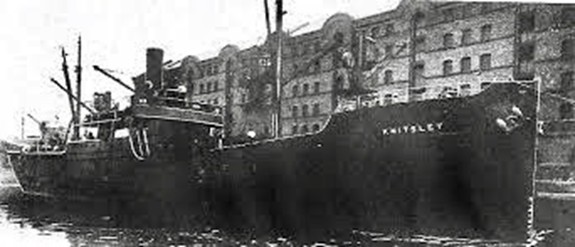
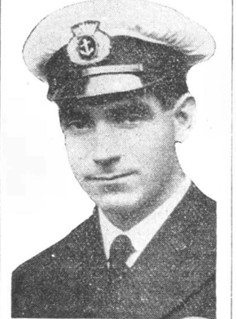
The ship’s captain was Frederick Robinson, who would later be awarded the OBE. He lived at 14 Hawarden Crescent, Sunderland. Other Sunderland men on board included seaman John George Wilson of Mitford Street, a man named Mr. Cunliffe, and messroom steward Mr. Dougherty.
On April 30, 1937, just a few weeks after the fascist blockade was declared, Captain Robinson and the SS Knitsley were transporting cargo to the port of Castro Urdiales on the northern coast of Spain. The ship was approached by two fascist vessels: the destroyer Velasco and the battleship España. The Velasco fired a warning shot, but Captain Robinson took evasive action and the shot missed.
Fortunately for the crew and their ship, Republican aircraft were made aware of the situation and came to their aid. They immediately attacked the España, which, while attempting to evade them, struck a mine and began to sink rapidly. As the Velasco went to assist the stricken battleship, Captain Robinson took full advantage of the diversion and made for the port without any further interference. By a quirk of fate, the mine that sank the España was actually a fascist one, laid to help enforce the very blockade they were trying to enforce.
The Aftermath and Legal Trouble
The very next day, on May 1, 1937, the crew reported that they listened to the FA Cup Final on the radio, in which Sunderland won, beating Preston North End 3-1. They also noted that an air raid took place shortly after the final whistle, but no hits or damage occurred.
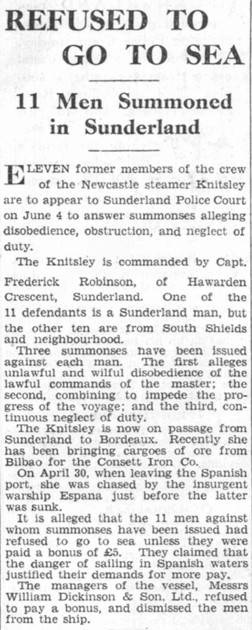
Upon the Knitsley’s return home in early May, a reporter from the Sunderland Echo managed to speak with the captain and crew. Captain Robinson stated, “I have received orders from the owners not to mention the happening,” although the reporter noted that he appeared “quite cheery.” This contrasted sharply with the crew members, who described the voyage as “quite terrifying.”
Eleven of the crew were so shaken by their experiences that they refused to sail in Spanish waters again unless they were paid a bonus of £5. The ship’s managers, William Dickinson & Son Ltd, refused and dismissed the men. The eleven sailors were then forced to appear in Sunderland Magistrate’s Court, where they were convicted of “conspiring to impede the ship’s progress.” Despite Captain Robinson speaking on their behalf and telling the court that the trip had indeed been far more dangerous than an ordinary commercial voyage, they were still convicted and each fined 40 shillings.
Final Years and Legacy
As was the fate of many British-registered ships that delivered aid to Spain and rescued refugees from 1936 to 1939, the Knitsley was sunk by Nazi Germany in World War II. On December 12, 1942, she was torpedoed by an E-boat just off the coast of Lowestoft while en route from London to Newcastle. Thirteen of her crew were killed.
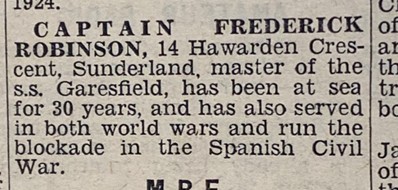
Captain Robinson was not on board that day. By then, he was the skipper of the SS Garesfield, a ship on which he served throughout World War II. Coincidentally, the Garesfield was also built in Sunderland at the Southwick shipyard by William Pickersgill & Sons Ltd.
In recognition of his service to the Merchant Navy during World War I, World War II, and the Spanish Civil War, Captain Robinson was awarded the OBE in the January 1946 New Year’s Honours List. He passed away on December 21, 1964, at the age of 66.
 Solidarity Park