


How Basque Refugee Children Found a Stage at Bede School, a Link to Today’s Sunderland College
A Legacy of Compassion: Sunderland and the Spanish Civil War
By Tony Fox
As so often seems to be the case, British government policy towards refugees in the 1930s was out of step with the compassion shown by British people. The National Government, along with other democratic governments in Europe, had chosen a policy of public non-intervention with regard to the warring factions in Spain, and thus their default position was to maintain a ‘hostile environment’ so far as immigration from Spain was concerned. However, church organisations, the Communist Party, some in the labour movement and the charity sector did not believe that non-intervention should mean the denial of humanitarian aid.
A delegation led by the Liberal MP for Cumberland North, Wilfred Roberts; later known as the ‘MP for Spain’, which included Ruth Pennyman of Ormesby Hall, travelled there in November 1936. From that visit the National Joint Committee for Spanish Relief (NJCSR) was established in January 1937, its broad-based leadership encompassed Communists, Conservatives, ILP members, Liberals, and some Trades Unionists not affiliated to the TUC. The Chair was the Conservative MP the Duchess of Atholl.
Public outrage at the bombing of Guernica (April 26 1937) and NJCSR pressure led the Home Secretary, Sir John Simon, to authorise the Joint Committee to bring 2000 children aged 5-15 to the United Kingdom, so long as the committee took responsibility for the arrangements and no public money was spent on the evacuation, the education or the welfare of the children whilst they were in the country, and provided that it would take responsibility for their eventual repatriation.
The NJCSR appealed for financial help, and sought to establish ‘colonies’ in buildings that could be made available as hostels, various organisations responded and each ‘colony’, established its own character, some had religious affiliations, others local political groupings and the Salvation Army also played a significant role: by May 311937 twenty buildings had been approved in the North East and Cumberland, although not all were used.
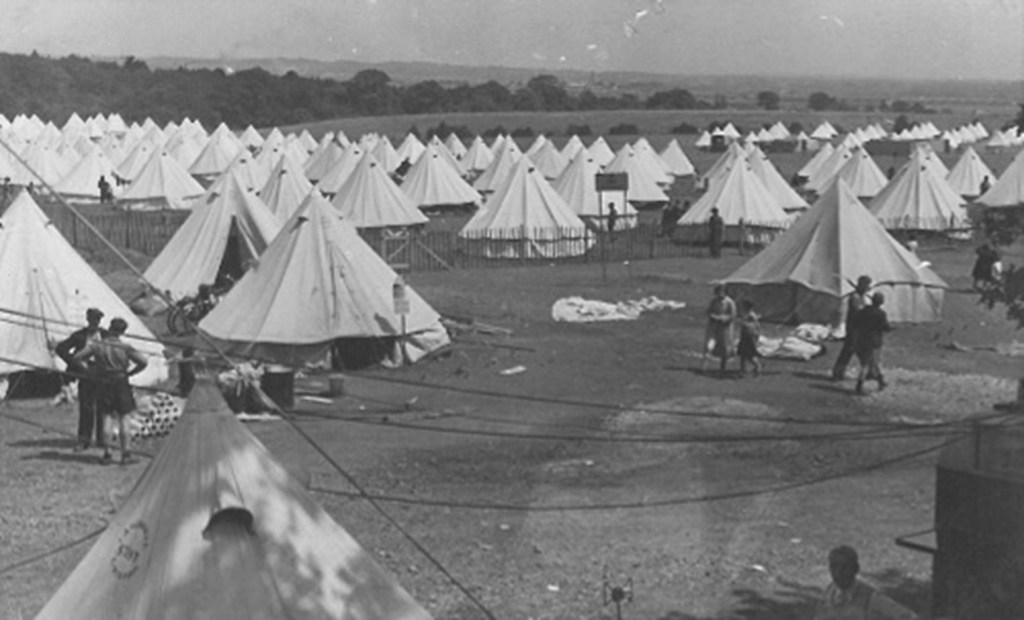
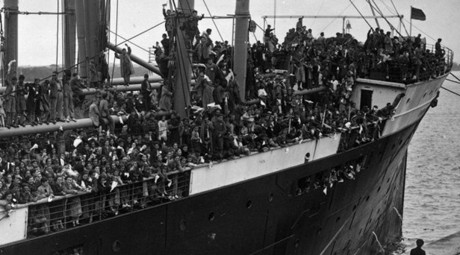
On May 23 1937 3,886 children, 96 teachers, 118 assistants and 16 Catholic priests arrived at Southampton from the Basque country on the liner SS Habana (it had been equipped to accommodate 800 passengers). The ship had been escorted from Spain by the British battleship HMS Royal Oak and the destroyer HMS Forester. Thousands of people lined the quayside, the Basque children were then sent to a camp at North Stoneham in Eastleigh that had been set up in three fields.
The first to offer asylum was the Salvation Army, who undertook to take 400, followed by the Catholic Church, who committed itself to take 1,200 children. Little by little, from the end of May, and during the summer, the children left the provisional camp in groups to go to other homes situated all over Great Britain and by mid-September all had been relocated.
Over 500 refugee children were cared for in the North East and Cumberland: the largest colony in the region was the St. Peter’s Home, Darlington, where 150 boys were housed, 100 girls went to St Mary’s Orphanage at Tudhoe, 100 refugees were housed at Brampton, 60 girls were placed in St. Joseph’s Home in Darlington, 40 went to Hutton Hall near Guisborough, 40 went to the colony in Percy Park and 20 in St Vincent’s in Newcastle.
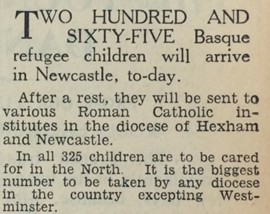
On Saturday 31st July 1937 the 40 children for the Tynemouth colony arrived at Newcastle Train Station. The group was met by the Mayor, John Grantham, and a delegation from the local JCSR led by Nell Badsey, secretary of the Spanish Aid Committee on Tyneside. They were taken to their accommodation at 40 Percy Park, Tynemouth.
The refugees at Tynemouth took some time to settle, the Artillery displays at Tynemouth Castle frightened the children who had experienced the bombing of their homes in Spain. The Percy Park hostel was run by a management committee headed by Nell Badsey. Donations to the Tynemouth colony from local people and miners’ lodges provided early funds, the committee also worked with the Communist Party and local support groups who organised jumble sales, raffles, street corner collections, concerts, socials and door to door collections.
Like many colonies the refugees at Tynemouth were assembled into a concert party that would raise funds by singing and demonstrating Spanish dance, this was usually in support of Nell Badsey who would give numerous talks.
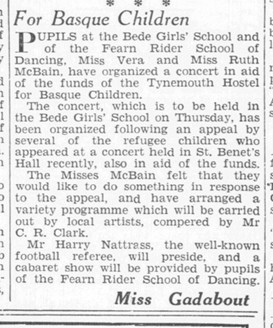
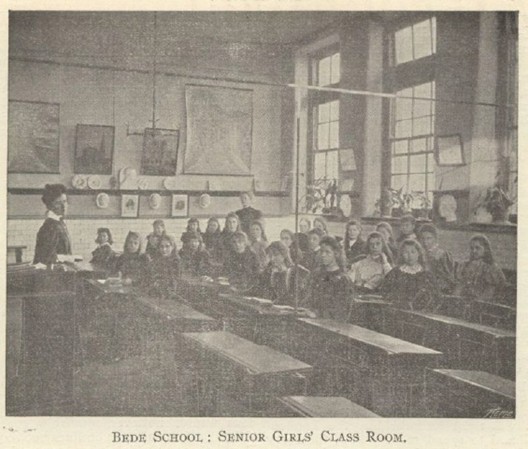
After a concert in the Church Hall of St Benet’s Catholic Church, Monkwearmouth the sisters Vera and Ruth McBain of the Fearn Rider School of Dancing (in May they had come third in the North Dance Championship for Duet Step Dance) with Nell Badsey organised a concert at Bede Girl’s School.
The Bede Collegiate School, for boys and girls opened on Stockton Road, Sunderland in 1905. In 1927 the building on Durham Road was begun, this is also the Year that International Brigade Volunteer Frank Graham first attended Bede Boy’s School; by 1929 the students had all transferred to the new building on Durham Road, which is now Sunderland College’s Bede Campus. In 1931 Frank Graham enrolled in King’s College London, after winning a scholarship.
Because of the government stipulation that no public money could be spent on the refugee children, almost all Basque refugee colonies organised fund raising concerts where the children would perform Basque songs and dances. However the concert in Bede Girl’s school is particularly unusual as this appears to be the only time Basque Children and English children performed in the same concert.
We have example of volunteers playing instruments whilst the children performed, and most famously Consuelo Carmona performing with the children; Carmona was a trained Flamenco performer and teacher, she worked with Ruth Pennyman and prepared the children at the Hutton Hall colony for concerts, most notably taking them to Switzerland in 1938 for a fund-raising tour. We have plenty of example where Basque boys and English boys competed in football games, but we have not found any other examples of Basque and English children performing together.
Harry Nattress presided at the concertin Bede School. At this time Football referees were amateur; Harry, of Corbett Street, New Seaham also worked underground as a Hewer at the Londonderry pit, New Seaham.
The year before the concert, in April 1936, he had refereed the FA Cup Final at Wembley, when Arsenal defeated Sheffield United; it was the first FA cup final in which commentators were used in the radio broadcast. In September 1936 Sunderland defeated Arsenal in the Charity Shield but for obvious reasons Harry did not referee. Later, in October 1936, Harry refereed the Scotland Vs Germany international match in which Scotland defeated Germany 2-0. Harry continued to work underground at the Londonderry pit and refereed until his retirement in 1947.
 Solidarity Park